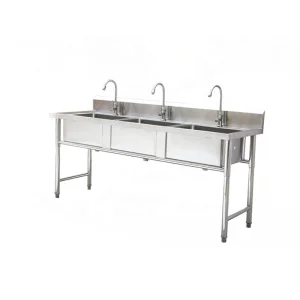
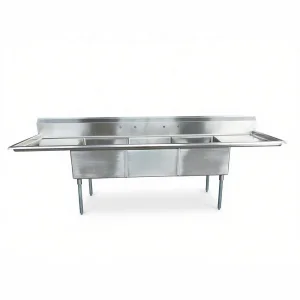
Engineered for compliance and heavy-duty sanitation. Explore our top 8 featured wash prep stations.
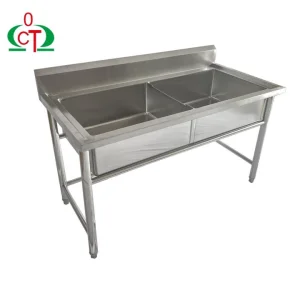
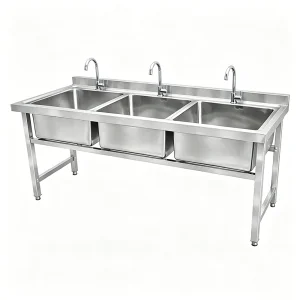
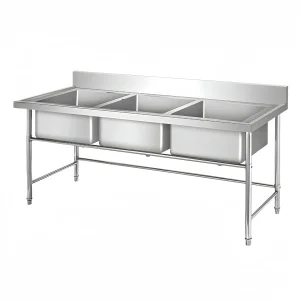
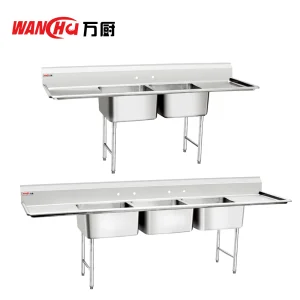
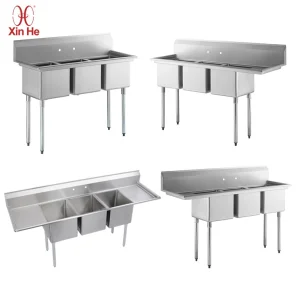
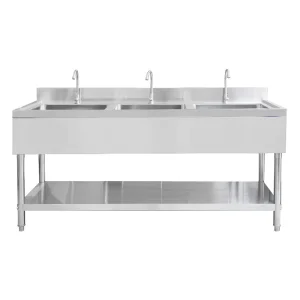
Within B2B commercial catering, industrial food processing, and high-standard medical facilities, sanitation is not merely an operational task—it is a critical point of regulatory audit. A premium Three Compartment Sink Station represents the operational cornerstone of manual warewashing and sanitizing protocols mandated by agencies worldwide, including the US Food and Drug Administration (FDA) Food Code, NSF International, and European standards (EN 10088).
These specialized sink stations partition the manual sanitation process into three clear steps: Wash (to remove large debris and clean using detergent), Rinse (to flush chemical cleaners off the ware with fresh water), and Sanitize (to expose the materials to thermal or chemical sanitation agents). Achieving seamless execution across these three states requires precise mechanical engineering, ergonomic structural designs, and raw materials optimized for extreme corrosion resistance.

Building high-performing kitchen equipment with rigorous manufacturing standards and complete certification compliance.
Shandong Linru Import & Export Trading Co., Ltd. is a professional enterprise integrating the production and sales of commercial kitchen equipment. With 15 years of experience in the field, we have grown from a single line of kitchen stoves to a diversified portfolio of high-quality branded products. From the very beginning, we have been committed to improving our product quality step by step, firmly believing that only by ensuring consistent quality can we truly earn our customers' trust and recognition.
In the field of refrigeration and heating equipment, we adhere to strict quality standards and rigorous requirements. Our heating products, including stoves, have obtained full-range CCC (China Compulsory Certification). In addition, our jacketed kettles are certified not only with CCC but also with the National Pressure Vessel Manufacturing License, ensuring customers can purchase with confidence and use with peace of mind.
Proven reliability, engineering certifications, and material longevity for industrial kitchen planning.
With 15 years of experience in commercial kitchen equipment manufacturing, Feijin Import & Export is committed to continuous product refinement, rejecting low-cost, low-quality shortcuts to ensure every piece of equipment delivers long-term stability and reliability.
For refrigeration products, Feijin Import & Export combines high standards with customization — guaranteeing full compliance with national quality standards while tailoring technical parameters to match each client’s specific application and usage environment.
Feijin’s stainless-steel preparation equipment is built using high-grade 304 or 201 stainless steel, with meticulous attention to load-bearing design, craftsmanship, and finishing details, ensuring both durability and aesthetic excellence.
With 15 years of experience in commercial kitchen equipment manufacturing, Feijin Import & Export is committed to continuous product refinement, rejecting low-cost, low-quality shortcuts to ensure every piece of equipment delivers long-term stability and reliability. From small-scale utility sinks to automated multi-station surgical hand wash stations, our commitment to consistent quality forms the basis of all global distribution partnerships.
A deep dive into materials chemistry, stress performance, and fluid dynamics within sanitation prep systems.
The selection of structural steel directly impacts the service lifespan of a three-compartment sink. AISI 304 Stainless Steel contains approximately 18% chromium and 8% nickel, generating a self-passivating chromium oxide layer that prevents oxidation, rust, and surface deterioration from strong acidic sanitizing solutions.
In environments with high salinity or chloride exposure (such as marine kitchens or facilities utilizing hypochlorite sanitizers), AISI 316 Stainless Steel containing molybdenum is selected for its enhanced pitting resistance. For cost-sensitive, dry environments, AISI 201 represents an alternative option, though it is more prone to surface rusting under high-humidity conditions unless properly dried and passivated.
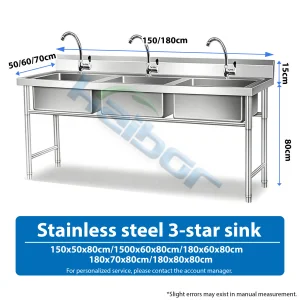
Kitchen utility sinks are subject to intense impact forces from heavy cast-iron cookware. Commercial stations from Feijin incorporate 14-gauge (approx. 1.9mm) or 16-gauge (approx. 1.5mm) sheets. The heavier 14-gauge structural panels minimize acoustic vibrations and prevent structural denting, ensuring the sink remains level to allow consistent drainage toward the waste outlets.
A key failure point in low-grade commercial sinks is standing water. Efficient drainage requires the integration of sloped drainboards pitched at a minimum angle of 0.25 inches per foot toward the sink bowls. Furthermore, custom backsplash structures prevent water from seeping behind the drywall, stopping mold growth and environmental pathogens.
For NSF approval in the United States and global sanitation audits, internal bowl corners must feature a minimum 1/4-inch coved radius. Fabricated sinks with sharp 90-degree corners create micro-crevices that harbor biofilms and bacteria. The seamless, deep-drawn construction design used in premium wash stations guarantees that all surfaces can be thoroughly scrubbed and sanitized without blind spots.
Understanding the regulatory requirements and functional layouts across different global jurisdictions.
Compliance: NSF/ANSI Standard 2, ASME A112.19.3, CSA B45.4.
Sinks must feature independent commercial plumbing fixtures, a high-rise gooseneck faucet with vacuum breakers to prevent backflow, and drainboard configurations to hold clean wares before and after drying. The grease trap connection is heavily regulated by local municipal plumbing codes.
Compliance: CE Mark, EN 10088 Steel Standards, WRAS.
Under WRAS (Water Regulations Advisory Scheme) in the UK, backflow prevention is critical. Three-compartment sinks are typically required to have a visible air gap (Type AA or AB) on inlet taps. Sinks are built strictly from EN 1.4301 (AISI 304 equivalent) to meet REACH chemical safety guidelines.
Compliance: CCC (China), JIS (Japan), AS/NZS 3500 (Australia).
Sanitation requirements in the APAC region focus on high-temperature resistance and chemical exposure protocols. Our automatic surgical hand-wash variations and heavy-duty utility sinks comply with medical and commercial regulatory codes, providing reliable protection against high-traffic load failures.
Anticipating the next generation of industrial hygiene stations through AI integration, resource efficiency, and ergonomics.
With water scarcity becoming a critical parameter for global commercial enterprises, future three-compartment stations will integrate flow-limiting valves and ultrasonic sensors to regulate flow rates depending on bowl volume load. The integration of localized heat exchange coils keeps the sanitize basin at a constant 171°F (77°C) with minimal electrical draw.
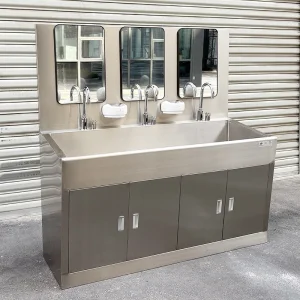
Expanding from our current Automatic Surgical Hand Wash Sink Triple Station, the next generation of food prep basins will incorporate automated timers, touchless soap and chemical sanitizing dispensers, and IoT-enabled temperature logs. These features allow operators to automatically record temperature data, simplifying HACCP validation processes.
Future fabrication updates from Feijin include physical vapor deposition (PVD) nano-coatings. These coatings provide oleophobic and hydrophobic properties, preventing water droplet scale formation and reducing the amount of chemical agents needed to keep the stainless steel clean.
Recognizing the diverse architectural footprints of global ghost kitchens and dark kitchens, modular framing systems will become standard. This allows operators to easily attach or swap drainboards, rack systems, and pre-rinse assemblies as required, providing flexibility for varying layouts.
Get answers to technical, logistical, and compliance questions about our three-compartment commercial sinks.
A: AISI 304 contains 8% nickel, which provides excellent resistance to corrosion from food acids, humidity, and sanitizing chemicals (such as chlorine and iodine solutions). AISI 201 replaces nickel with manganese; it is more cost-effective but prone to surface rust and pitting when exposed to water and chemicals over long periods.
A: The FDA Food Code requires three distinct phases: wash (minimum 110°F / 43°C water with detergent), rinse (clean water), and sanitize. Sanitization must be achieved using either hot water at a minimum of 171°F (77°C) or chemical sanitizers mixed to the manufacturer's specified concentrations.
A: Coved corners feature a minimum 1/4-inch radius curve instead of a sharp 90-degree angle. This design eliminates hard-to-reach crevices where food waste, grease, and bacteria can accumulate. It allows inspectors to easily verify that the sink is clean and makes washing the basins fast and efficient.
A: Yes, we provide full OEM and ODM customization services. We can adjust the dimensions of the bowls, customize the height of the backsplashes, configure the position of the drainboards, and pre-drill faucet holes to match your layout and municipal code requirements.
A: Our products are manufactured to NSF/ANSI Standard 2 compliance standards. Furthermore, our manufacturing facility holds CCC and National Pressure Vessel Manufacturing Licenses, showing our commitment to high-pressure thermal testing and consistent manufacturing quality.
A: The smaller the gauge number, the thicker the steel. A 14-gauge sink is approximately 1.9mm thick, providing excellent structural strength, impact resistance, and sound dampening. A 16-gauge (1.5mm) sink is the standard for commercial kitchens, while an 18-gauge (1.2mm) sink is best suited for light utility or hand wash applications.
Premium 3-compartment options, specialized double-basin stations, and custom dual-tier storage configurations.
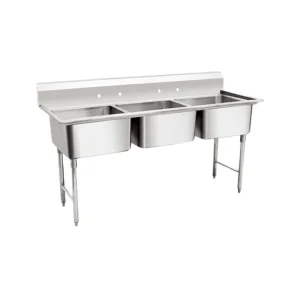
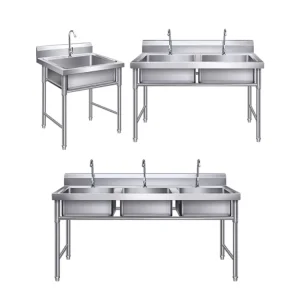
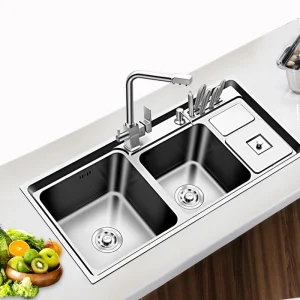
 Linru Kitchen Equipment